Production of H&G Magetan Tempe Chips More Efficient, UNESA Accompanying Use of Modern Machinery
JPPM Editorial Team 2 min read 12 views
Surabaya State University (UNESA) through the Community Partnership Program (PKM-PU) team is assisting H&G (Hage) Tempe Chips MSMEs in Tebon Village, Magetan Regency, in utilizing a deep fryer and two-story production oven. This assistance is carried out to help partners increase the smoothness of production while maintaining the distinctive taste of tempeh chips.
Previously, the frying process at H&G Tempe Chips UMKM was still done semi-manually. This method requires time and intensive supervision, especially when market demand increases. Inconsistent temperature settings also risk causing product color and crispness to vary. This condition encourages the need for appropriate technology that can support the production process without changing the character of the product.
The UNESA PKM-PU team consisting of Tukiran, Yunus, and Woro Setyarsih designed the building and handed over two units of equipment, namely a frying machine and a two-story production oven. After the equipment is installed at the partner location, the team provides direct assistance through technical explanations, discussions and practices in the production area. Monitoring is also carried out online to evaluate the use of tools in daily activities.
At the frying stage, operators receive training regarding temperature regulation, basket use and oil draining. The operational guidelines in the activity document state that the working temperature is around 160-170 degrees Celsius with a frying time of around seven minutes per cycle. The tempeh slices are added in stages so they don't pile up on each other and can cook more evenly. Once cooked, the chips are drained using a special holder so that the remaining oil returns to the tank.
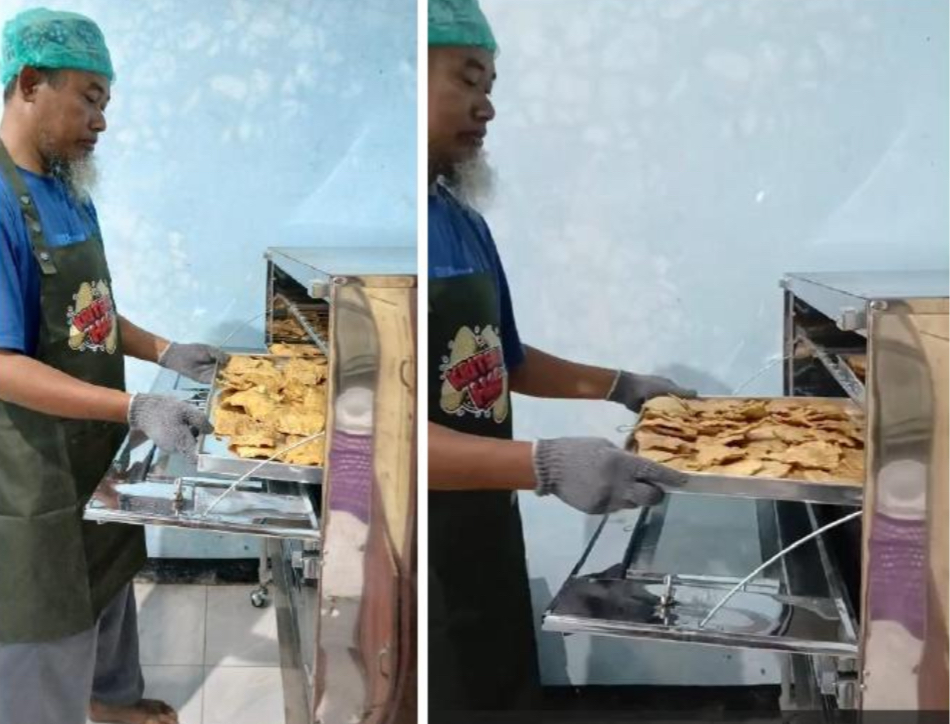
The assistance then continued with the use of a two-story production oven. The chips that have been fried and drained are arranged on a baking sheet, then placed in the oven for further drying. Operators are trained to regulate the temperature via a thermostat and monitor the process via a sight glass on the oven door. This stage aims to reduce remaining moisture and oil in the product so that the chips are crispier and don't get soft easily. The team also reminded the importance of maintaining equipment cleanliness and checking supporting parts before and after production.
According to the evaluation stated in the activity document, both machines function well and can be operated by partner production personnel. The frying and drying process is shorter than the manual method. The cleanliness of the production room increases, the shape of the tempeh slices is better maintained with less crushing, and the physical burden on workers is reduced.
Through this assistance, UNESA encourages the use of appropriate technology accompanied by operational training so that it can be used optimally. For H&G Tempe Chips MSMEs, the use of frying machines and ovens is expected to support more efficient production and help maintain the quality of tempeh chips.
Submitted by Najwa Zein, Surabaya State University.
Serang, 13 November 2026 – The Research and Community Service Network (JPPM) held the final coordination meeting for preparations for the Smart Gen Z Literacy Training on Friday...