La Tansa Mashiro University and Bumigora University Invite Gen Z to Build Account Security and Beware of Digital Fraud
JPPM Editorial Team 3 min read 103 views
Serang, November 14 2026 – That morning the Smart Gen Z Literacy Training Zoom room started to get busy at 07.30 WIB. One by one the participants join, change their display name, then prepare to take part in the first session. The Community Service Activity (PkM) National Collaboration III which was organized by the Research and Community Service Network (JPPM) together with collaborating universities was attended by 103 participants from 208 registrants, consisting of pupils, students, parents and the general public from various regions.
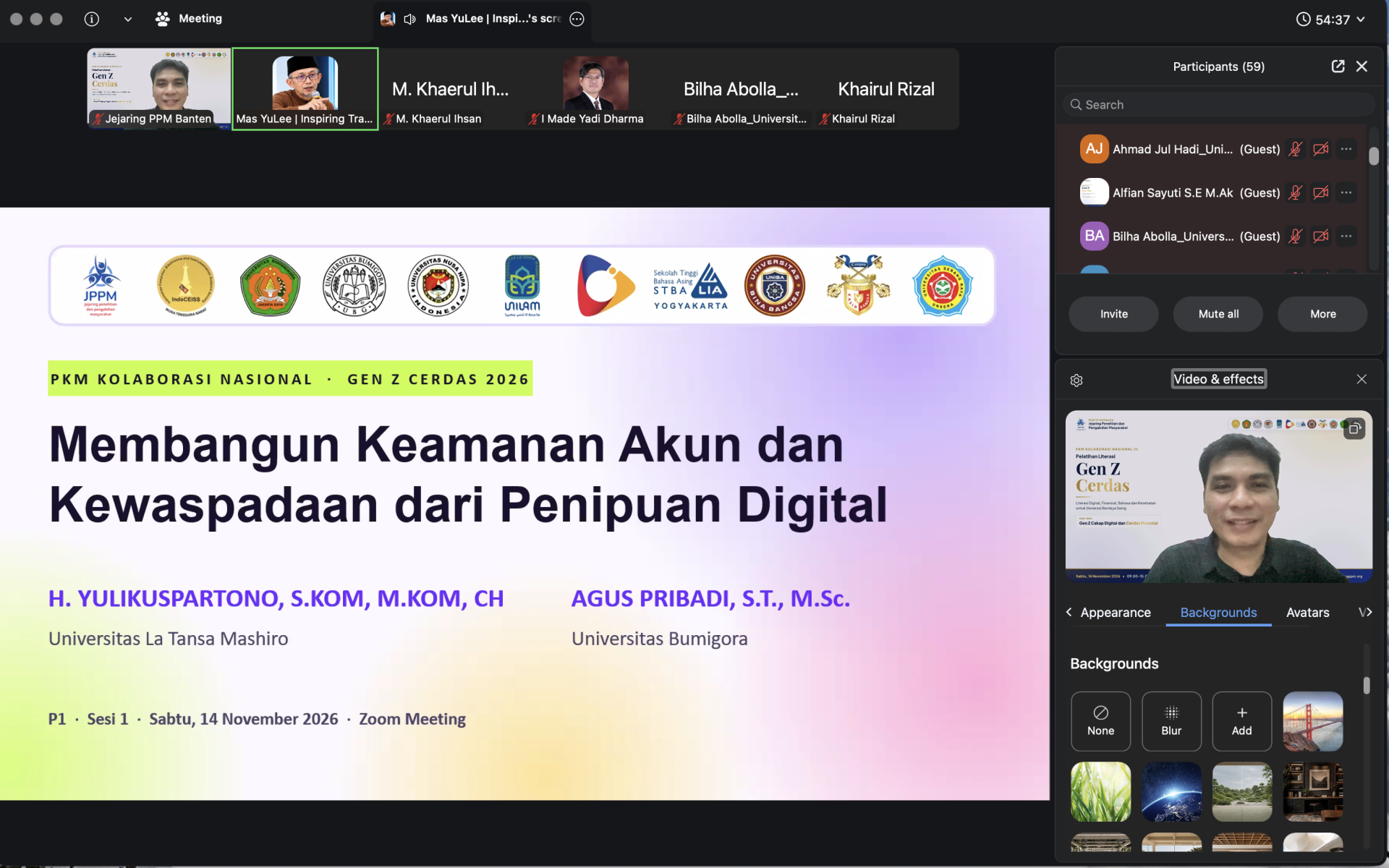
The opening session featured material "Building Account Security and Precautions against Digital Fraud" presented by two speakers from two different campuses: H. Yulikuspartono, S.Kom., M.Kom., CH from La Tansa Mashiro University (UNILAM) and Agus Pribadi, S.T., M.Sc. from Bumigora University, Mataram.
Both have a scientific background that is in line with the material. Yulikuspartono is a lecturer with the functional position of Lector who took a Bachelor's Degree in Information Systems at STMIK Gunadarma and a Master's Degree in Computer Science in E-Business at STMIK Nusa Mandiri. He once served as Dean of the UNILAM Faculty of Information Technology and is currently Director of PUSDIKOM UNILAM. Apart from studying informatics, cyber security and digital marketing, he is known as an educational motivator who has won three MURI records and holds BNSP certification in the fields of public speaking and digital marketing. Meanwhile, Agus Pribadi is a lecturer at Bumigora University with a background in information technology, geomatics and wireless networks. He holds a Master of IT for Natural Resource Management and has experience as an IT and business practitioner. This combination of academic, technical and practical experience makes digital security material delivered in a coherent and down-to-earth manner.
The material opens with a simple question: what do we leave behind on the internet? Participants are invited to understand active digital traces, such as uploads, comments and reviews, as well as passive digital traces that are recorded without realizing it, such as location, search history and application activity. The interviewee emphasized that digital traces are difficult to erase and can influence school selection, scholarships, internships, and the world of work.
The discussion then turned to personal data protection. Participants were introduced to the types of data that must be protected, such as NIK, photo ID card, password, PIN and OTP code, as well as the "borrow cellphone" mode which could lead to taking over the WhatsApp account. Sources shared preventive measures, including not lending cell phones to strangers, checking call diversion, and activating two-step verification. In the account security section, participants learn to create strong and different passwords for each account, understand the function of two-factor authentication (2FA), and recognize common modes such as phishing, social engineering, impersonation, fake gifts, fake scholarships, fake recruitment, and emergency messages.
The material comes to life through three case studies. The first case, "One Post, Many Consequences", describes an outstanding student who uploaded a video humiliating his friend that went viral and had an impact on his reputation during scholarship selection. The second case, "Free Scholarship, but Requested for Photo of KTP and OTP", invites participants to recognize red flags such as urgent deadlines, unclear identity of the sender, and requests for confidential data. The third case is a real case that was uncovered by the Makassar Police in October 2025: the perpetrator hijacked the WhatsApp account to impersonate someone the victim knew, until the victim transferred money with a total loss of IDR 50 million.
Before the session ended, participants took a Digital Security Literacy Quiz containing five questions, starting from understanding digital footprints, the right attitude when receiving an unsolicited OTP, the reason passwords must be different for each account, the function of 2FA, to how to respond to scholarship offers with foreign links and a time limit of 10 minutes. The session closed with five digital security principles: think before you upload, protect personal data, use unique passwords, enable 2FA, and stop, check and verify. The closing message is easy to remember: "Don't trust easily, don't just share, don't just click."
Serang, 14 November 2026 – The Smart Gen Z Literacy Training Series entered its final session late in the afternoon. National Collaborative PkM Activity III which was held...
Serang, 14 November 2026 – After the lunch break, the Smart Gen Z Literacy Training participants returned to the Zoom room for the fifth session. National Collaborative PkM Activities III...
Serang, 14 November 2026 – "So that your finances don't just have FOMO, but actually GROW since school!" The invitation opened the fourth session of Gen Z Literacy Training...